|
|
There have been numerous academic and scholarly studies of the many streams of Freemasonry and their various rôles in political history. Unfortunately free range theorizing can erroneously lead to agenda-driven conclusions assigning masonic responsibility to global events.
|
|
|
|
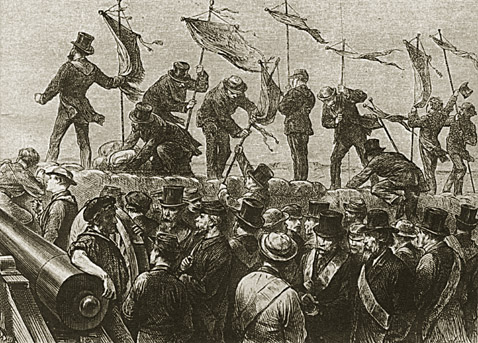
Freemasons on the barricades of the Paris Commune, 29 April 1871.
|
|
THIS IS A WORK IN PROGRESS REQUIRING EXTENSIVE EDITING
Freemasonry and nineteenth-century revolution
|
 |
| |
There is no question that, as Marxist historian Boris I. Nicolaevsky wrote, "secret societies, some outwardly of masonic form, played a decisive rôle in the forming of the First International."1 But a vague use of terms and a selective use of facts has allowed masoniphobes, conspiracy theorists, and those promoting their own agendas to erroneously conclude that Freemasonry as a body played a large rôle in what was to become three political movements: communism, socialism and anarchism.
|
|
|
|
The claim is frequently made, often without comment, rarely with citation, that several early promoters of modern anarchism, Mikhail Alexandrovich Bakunin (1814-1876), Pyotr Alexeyevich Kropotkin (1842/12/21-1921/02/08) and Pierre-Joseph Proudhon (1809/01/15-1865/19/01) amongst others, were Freemasons.2 The further claim will also be made that many of the participants in the First International (1864/09/28-1876/07/15), the Commune Révolutionnaire3, and the Paris Commune (1871/03/28-1871/05/28) were Freemasons, and therefore that modern communism or the anarchist movement are masonic constructs.4
Here are described the usual suspects in most theories linking Freemasonry with anarchy. Whether or not any of these men were Freemasons, it would appear that they all had one thing in common with Freemasonry: a belief that it was possible to build a better world.
|
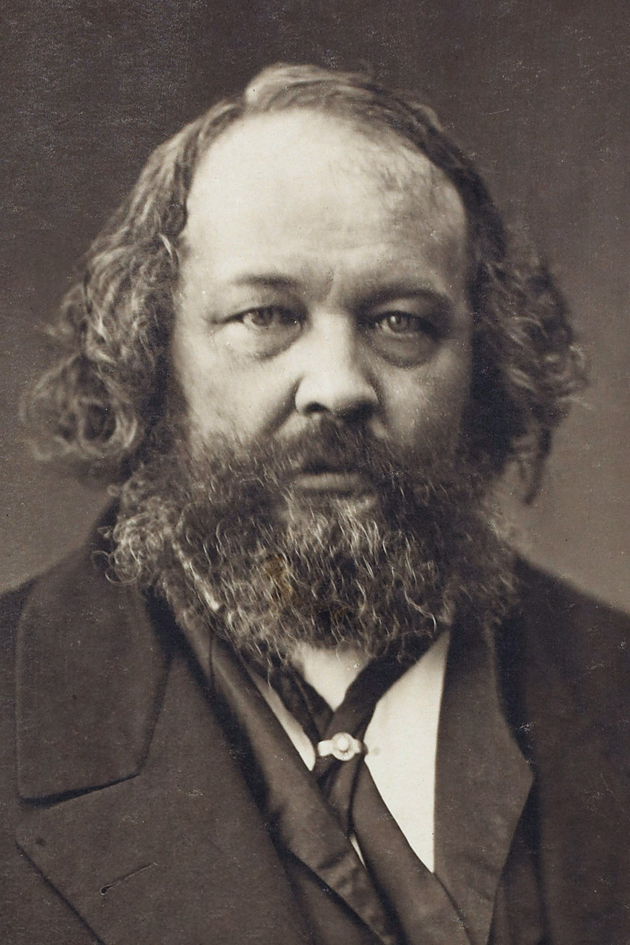 Bakunin (1814-1876)
|
Mikhail Bakunin
The question of Michael Bakunin's association with Freemasonry raises several complications.
T.R. Ravindranathan reports that "In the mid-1840s in Paris he had joined a Masonic lodge" noting "there is no record of his having actively participated in the Masonic movement".5 Unfortunately he doesn't name the lodge, only referring to it as a "Scottish lodge of the Grand Orient of Paris".
Bakunin's relationship with Italian Freemasonry is clearer. He joined the self-styled masonic lodge Il Progresso Sociale in Florence sometime in 1864-65. Two points should be stressed. First, his correspondence makes it obvious that Bakunin had no interest in Fremasonry other than as "as a cover and tool for his revolutionary purposes".6 Second, Italian Freemasonry at the time was in a state of some confusion. From 1864 to 1867 there were, simultaneously, four masonic bodies claiming jurisdiction in Italy, all of which were politically active and not recognized by regular Freemasonry.7 From the available records it is unclear from which of the four bodies Il Progresso Sociale took its membership; most probably the Grand Orient of Italy at Turin— established 1 January 1862—which restricted itself to the three Craft degrees. What is clear is that it was a politically inspired break-away group with no claims to masonic legitimacy.8
There is no evidence as to how Bakunin tried to infiltrate and use the Masonic machinery for his revolutionary purposes other than a letter he wrote to Herzen and Ogarev from Naples on 23 March 1866, explaining his fleeting romance with Freemasonry: "I only pray to you, friends, not to think that I ever seriously occupied myself with Freemasonry. This can be useful as a mask or as a passport, but to look for anything serious in Freemasonry is no better, if not worse, than to seek consolation in wine." Then he told his correspondents that he would speak to them no more about Freemasonry.9
Ravindranathan notes that Bakunin wrote a long manuscript on Freemasonry in 1865 "which was lost", but claims fragments of his so-called "Catechism of a Freemason," have survived. In it he pronounced the famous aphorism:
God exists, therefore man is a slave.
Man is free, therefore there is no God.
Escape this dilemma he who can!10
This syllogism is found in Bakunin's Fédéralisme, socialisme et antithéologisme (1867), which makes no mention of Freemasonry. If a "Catechism of a Freemason" exists, it was never published. Claims that Bukanin wrote something that he titled a "Catechism of a Freemason" would appear to be as substantial as accusations that he was a satanist.11
|
 Kropotkin (Félix Nadar photo, detail)
|
Pyotr Alexeyevich Kropotkin
Claims for Kropotkin's masonic membership12 appear to be based solely on his Memoirs, wherein he notes meeting in the early spring of 1872 "at the spacious Masonic Temple Unique", in Zürich. From this the conspiracy-minded can conclude that he was a Freemason, but Kropotkin doesn't write that it was a masonic meeting, only that his section of the International Workingmen's Association met in a masonic building. 13
|
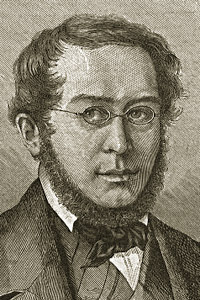 Pierre-Joseph Proudhon (1809-1865)
|
Pierre-Joseph Proudhon
As for Proudhon, while there is some confusion in what has been reported, Proudhon's is the strongest claim to masonic affiliation. Although Alec Mellor claimed Proudhon became a Freemason in Dijon in 1849, Proudhon himself claimed in Justice to have been initiated on January 8, 1847 into the Besançon Lodge, Sincérité, Parfaite Union et Constante Amitié.14
What is clear is that, regardless of what contact these men had with Freemasonry, there is no evidence that their politics had any real impact on Freemasonry, or that the teachings of Freemasonry had any influence on their politics.
Loge des Philadelphes
It is from the membership of the Loge des Philadelphes, a lodge under the masonicly irregular Order of Memphis15 that the First International is claimed to have drawn its founding members—although, as detailed below, the facts do not bear out this claim.
Formed out of the French refugee membership of Les Sectateurs de Ménès, La Grande Loge des Philadelphes was established at the end of 1850. Its constitution was ratified by the Conseil Supreme de l'Ordre Maçonnique de Memphis on 31 January 185116 Originally working the 95 degrees of the Rite of Memphis, after 8 April 1857 it only worked the three Craft degrees.17
On 7 November 1866, the Philadelphes, by a large majority, agreed to open their works 'Au nom de la Raison et de la Fraternité Universelle' — to accept atheists as members. This was eleven years before the Grand Orient of France took the same step which estranged them from the rest of reguar Freemasonry. In January 1868, it was decided to merge the two London lodges, which became known as Les Philadelphes et Concorde Réunis. A minority decided to keep the old Philadelphes lodge in existence, so that, confusingly, there were soon again two London lodges: Les Philadelphes and Les Philadelphes et Concorde Réunis."18
"Presumably [Montague Richard] Leverson also joined the lodge at Bernard’s instigation. Moreover, Austin Holyoake is also listed as a member of the lodge. Thus, the Philadelphes included three of the most prominent figures of the English free thought movement." "The old Philadelphes lodge which had continued in existence after 1868 as a protest against Benoit's proceedings, fizzled out in 1871, but the Philadelphes et Concorde Réunis continued to be very active throughout the 1870s."19 Prominent among the diners at a banquet for Charles Bradlaugh was a delegation from the Philadelphes et Concorde Réunis, led by Le Lubez, a republican from the Channel Islands and a member of the First International.20
"In November 1873, Le Monde Maçonnique reported that a group of French masons in London had provisionally formed a lodge under the title L'Union Maçonnique."
Le Monde Maçonnique 15 (1873-4), pp. 334, 430, 514; Combes, op. cit., pp. 48-9. cited by Prescott p. 28
"La Loge Les Philadelphes et Concorde Réunisî, was held at 71 Dean Street, Soho, in 1870, and at that time, Marc Ratazzi, Massac, Delpeche, Poirsou, and Jourdain, were the principal office bearers of the Lodge. These men I am informed are all of extreme Republican opinions. I have also ascertained that at that time the Lodge was visited on more than one occasion by Messrs Bradlaugh, Odger,141 and Gustave Flourens"
The Freemason (1 July 1876), pp. 304-5; (8 July 1876), pp. 317-8; (22 July 1876), p. 329. cited by prescott p. 29
It continued to exist until the late 1870s. During this time it had about 100 members. Between 1853 and 1856 some ten lodges of the Rite of Memphis were established.[1]
[ Professor Jean Bossu, "Une loge de proscrits 'a Londres sous le Second Empire et aprés la Commune" in the January-October 1958 issues of L'dée libre., a now-defunct monthly magazine published in Herblay (Seine-et-Oise), distributed only to members of French masonic lodges, cited by Nicolaevsky. ]
In March 1859 Bradlaugh joined the masonic lodge which had been formed by French refugees in London, the Grand Loge des Philadelphes. [Prescott p. 15]
French émigré physician Simon Bernard was Bradlaugh's sponsor when in March 1859, the year after Bernard's trial, Bradlaugh joined the masonic lodge which had been formed by French refugees in London, the Grand Loge des Philadelphes
An 1863 directory of the Philadelphes discovered by George Draffen 65
[Annuaire pour l’exercice 1863-4 Orient de Londres (1863). It was presented by Draffen in 1984 to The Library
and Museum of Freemasonry in London, where it has the classmark BE 682 PHI: subject file 'Rite of Memphis'.] : lawyer Montague Richard Leverson, Austin Holyoake
After Napoleon's coup d’état, the Rite of Memphis was suppressed in France, and in 1853 Les Sectateurs de Ménès became the Grand Lodge of the Order, taking the title Grand Loge des Philadelphes.70
Between 1853 and 1856, other lodges of the Rite of Memphis were opened in London
(Gymnosophistes; Fraternité des Peuples; Disciples d'Hermès; Conseil des Grands
Régulateurs de la Maçonnerie) and Birmingham (L'Avenir).
[Prescott, citing Combes, Des origines du Rite de Memphis, p. 46. "According to a note by John Hamill on the 'Rite of Memphis' subject file, this lodge was gradually taken over by French-speaking English Masons between 1863-6."]
|
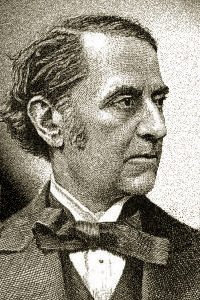 Louis Blanc
|
Louis Blanc
Louis Jean Joseph Charles Blanc (1811/10/29 - 1882/12/06) was a politician, historian and republican socialist, but he was not sympathetic to the Paris Commune. To him may be ascribed the oft quoted description of communism: From each according to his abilities, to each according to his needs.
] was initiated into Les Sectateurs de Ménès, not La Grand Loge des Philadelphes [Prescott AQC 203 p. 15 ]
While the origins of the lodge can be found in the non-political, and perhaps spiritually esoteric, Order of Memphis, in the main its membership was politically republican and socialist. But the members brought their politics with them, they did not find them in the lodge. They also brought their friends and associates with them, men unmoved by the lessons of Freemasonry but who were attracted to an existing group sympathetic to their radical politics.
None of the numerous biographies of of Louis Blanc makes any special mention of his activities as a Freemason or as a member of secret societies in general.11 Nor are there any traces of such activities in the Louis Blanc papers in the Bibliothèque Nationale in Paris.12 But in histories of Freemasonry, Blanc long has figured as one of the leading representatives of the Order of Memphis;
Bossu does not list him as a member of the Lodge of the Philadelphians, but he refers to Blanc's speeches at meetings organized by the Lodge (for example, at an 1870 banquet in honor of Paolo Tibaldi on his return from Cayenne). We learn from Bossu that in 1855 Louis Blanc was actually a member of the Supreme Council of the Order of Memphis.14
Although Nicolaevsky first makes the broad statement:
The part played by individual Philadelphians in 1864 was enormous; Victor Le Lubez, to name only the most important, personally undertook the tremendous work of organizing the meeting of September 28, 1864, at which the General Council of the First International was elected. The General Council of the International was selected by Le Lubez, and included a large and influential group of Philadelphians.36
He tempers his claim by demuring :
We do not know enough about the members of the General Council to establish precisely how many of them were Philadelphians or their allies,37 but we do know that of eight non-Englishmen elected to the first General Council, Six were Philadelphians or Mazzinists, who, as we have seen, were then allied with the Philadelphians. And the influence of the non-English members of the General Council was much greater than their number would suggest. By November 29, the membership of the General Council had increased to 58, and the new members were primarily candidates proposed by Le Lubez. The French group in the General Council grew from three to nine, eight of whom were Philadelphians; and the number of non-English members who were definitely allies of Le Lubez—among whom I count all the Italians and Poles of Emile Holtorp's group—grew from six to 18 at the meeting of November 29, an increase, that is, from 19 per cent of the total membership of the General Council to 31 per cent.38
Nicolaevsky fails to mention that of the twenty-three members elected to the provisional Central Committee, at St. Martin’s Hall, London, on 28 September 1864, only three: Victor Le Lubez, J. B. Bocquet and J. Denoual could have been members of Loge de Philadelph. Of the nineteen appointed between 12 October and 29 November, only three were proposed by Le Lubez.
On the other hand, it has also been claimed that the meeting had been called by leaders of the London trade unions. Le Lubez took part in the inaugural meeting but was expelled from the General Council in 1866. Nicolaevsky interpretation of Le Lubez's influence is not born out by the available minutes.
http://www.marxists.org
http://www.marxists.org
http://www.marxists.org
The Order of Memphis
Whether or not the Order of Memphis was a masonic body is to some degree a question of perspective. Certainly, to regular and recognized Craft Freemasonry—such as those jurisdictions then recognized by the United Grand Lodge of England and the Grand Orient of France—the Order of Memphis was irregular and clandestine.10 In other words, it was poaching. Non-masons will have a broader acceptance of what constitutes Freemasonry and may not make the distinction, although members of regular and irreegular bodies would have had little or no contact.
While all regular and recognized Freemasonry evolved from systems developed in Ireland, Scotland and England, the rituals of the Order of Memphis were loosely inspired by Cagliostro's clandestine Egyptian Rite—which he had invented out of whole cloth as a scheme for exploiting Freemasons. The Primitive Rite of Memphis was created by Samuel Honis at Cairo in 1814. Promoted by Gabriel-Mathieu Marconis de Negre in Montauban, France, until 1816, the rite was revived by his son, Jacques-Étienne Marconis de Negre (1795/01/03 - 1868/11/21), commonly known as Marconis, at Paris in 1838. He met with little success and the few lodges he had formed, in Paris, Marseilles and Brussels, were suppressed by the police in 1841. Revived again in 1848 as the Rite of Memphis, perhaps ten lodges were later absorbed into the Grand Orient of France in 1862 and their "higher degrees" recognized but not permitted to be conferred.
To the chagrin of the Grand Orient of France, Marconis continued to sell memberships outside France. The United Grand Lodge of England had issued a warning on 24 October 1859, advising its members that the Rite of Memphis was an irregular body. The promotion of the later Rite of Misram by Robert Wentworth Little, the attempt to plant the Rite of Memphis in America by Harry J. Seymour, and current manifestations of the rites are of no political relevance and are not part of this history.*****
The First International
Nicolaevsky is very clear in stating that regular Freemasonry, as a body, was never a factor in the formation and development of the First International, or International Workingman's Association (IWW) :
"Outwardly, these groups had the form of a masonic organization and bore a masonic name, the Lodge of the Philadelphians (Loge des Philadelphes). Some of the members may in fact have considered themselves masons. But veteran masons, those, who headed the lodges, must have realized that their lodges had little in common with real masonry."4 [p. 38]
He goes on to say, "They did not maintain organizational ties with official masonry either in France or in England" [p. 39] and describe it as "one of those secret societies which outwardly imitated the masons but which were essentially conspiratorial political organizations." [p. 40]
Nicolaevsky notes that "revolutionary masonry" was not considered real masonry. But he still terms it masonry which allows subsequent, less fastidious writers to falsely label the revolutionary movements as masonic inspired.
Nicolaevsky's conclusions are supported by Jacques Freymond, who wrote :
In a study of the IWA [International Workingmen's Association, sometimes called the First International] published 16 years ago[8], we said it was impossible to know whether Freemasonry had had a hand in it. Subsequent research has not resolved the question.11 [p. 7.]
Certainly, any link with the Loge des Philadelphes appears tenuous. While the membership of the Central Council of the First International fluctuated—with 56 signatures on their Address to U.S. President Lincoln—it started with twenty-three. At a meeting of 5 October 1864, The Bee-Hive newspaper of 8 October 1864 (No. 156) reports that about forty people were present. Of these, only Victor Le Lubez is confirmed as a member of the Loge des Philadelphes.
Unfortunately, even Nicolaevsky is prepared to ascribe masonic membership without citing his sources or providing any corroborating evidence. First International General Council members Charles Longuet (1833-1903) and Paul Lafargue (1842-1911), ["It was also during his years at the Faculty of Medicine tha Lafargue, like many republican opponents of the Empire, became a Freemason. Yet the record is not clear. One account describes him as a member of the lodge L'Avenir and as having later been dropped for failure to pay dues. :'Avenir was a free-thinking lodge that attracted law and medical students. The lodge's archives in the Bibliothèque Nationale, however, which include membership lists from 1865 to 1874, contain the names of other medical students but not those of Lafargue and Jaclard. Lafargue must have belonged before 1865, belonged to another lodge, or belongerd to none. The point is not vital: as Jacques Girault argues, republicans and socialists often joined without any real commitment to masonic principles."
Paul Lafargue and the Founding of French Marxism, 1842-1882ÊBy Leslie A. Derfler, Cumbreland, Rhode Island, Harvard University Press : 1991 p. 24 ISBN : 0-674-65903-1]
and Paris Commune member, Pierre Vésinier (1826-1902)—who is claimed to have been initiated in 1865—are noted without citation, although Nicolaevsky credits the research of Dr. Jean Bossu.8
The Paris Commune
Many, if not all, Parisian Freemasons, members of lodges under the Grand Orient of France *** were supporters of the Paris Commune of 1871. Minutes of a meeting of Loge L’Union de Belleville, held 28 April 1871, exemplify the sentiments that motivated a reported 10,000 Freemasons to mount the barricades the following day.D
The 92 members of the Commune (or, more correctly, of the "Communal Council") included a high proportion of skilled workers and several professionals (such as doctors and journalists). Many of them were political activists, ranging from reformist republicans, through various types of socialists, to the Jacobins who tended to look back nostalgically to the Revolution of 1789.
Louis Auguste Blanqui
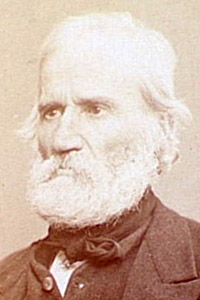 Louis Auguste Blanqui
| |
One man, the veteran leader of the 'Blanquist' group of revolutionary socialists, Louis Auguste Blanqui, was elected President of the Council, but this was in his absence, for he had been arrested on 17 March and was held in a secret prison throughout the life of the Commune. The Commune unsuccessfully tried to exchange him first against Mgr Darboy, archbishop of Paris, then against all 74 hostages it detained, but that was flatly refused by Adolphe Thiers (see below). The Paris Commune was proclaimed on 28 March, although local districts often retained the organizations from the siege.
Although Karl Marx had made a joking reference to the Freemasons in an 18 July 1871 interview, his history of the Commune, published in 1895, makes no mention of Freemasons or the lodges.The Commune of Paris : being the addresses ... on the Franco-German war of 1870, and the pamphlet of the same body, The civil war in France, of 1871, Karl Marx; with an introduction by Friedrich Engels; translated from the German by E. Belfort Bax. [ The civil war in France, of 1871. ] London, [1895?]. 47p.
The Manifesto issued by Freemasons on 8 April 1871 doesn't apppear to have had much influence.
But, while Gérald Dittmar identifies members of the Paris Commune as Freemasons without qualification— as does Milorad M. Drachkovitch for members of the International Workingman's Association and Alberto Valín Fernández for "the labour movement".12—he fails to distinguish between political clubs masquarading as masonic and regular masonic lodges.
Samuel Stephenson claims that French geographer and anarchist Jacques Elisée Reclus (1830/03/15 - 1905/07/04), exiled for his role in the Paris Commune, was "actively involved" in Freemasonry, but he fails to document the claim, only saying that Reclus was ""Probably a member of the Lodge of the Philadelphians (1852)" and a "member of the Freemasonry (1864)"
["Jacques Elisée Reclus", Samuel Stephenson http://academic.reed.edu/formosa/texts/reclusbio.html accessed 2007/07/25]
"Two members of the Philadelphes
et Concorde Réunis were elected to the commune, while others, such as Edouard Benoît, fought on its behalf."119
Combes, Les Philadelphes et les autres loges de Communards réfugiés, p. 37.
cited by Prescott p. 26
The Philadelphians
Who were the Philadelphians? Garibaldi was made an honourary member when he visited London in April 1864 but attending a banquet in his honour appears to have been the extent of his participation. Charles Bradlaugh was a member, but he too was opposed to socialism. Socialist Louis Blanc was a member, but he opposed the Paris Commune. Paul Lafargue? His name doesn't appear on the lodge roll. Anarchist Jacques Elisée Reclus? Like socialist labour leader Alexandre Auguste Ledru-Rollin (1807/02/02 -1874/1/31), and so many others, his membership is claimed without evidence.
"Who precisely were the founders of the Lodge is unknown. Yet if we juxtapose the names on Bossu's list with those of known political activists among the French emigres, we find a close connection between early members of the Lodge and a political grouping known as La Commune Revolutionnaire, which emerged soon afterward." [8 Nicolaevsky]
,
Bossu cites a quotation from Le Monde Maçonninque for 1874, which states that in 1859 Garibaldi, Mazzini, Charles Bradlaugh, and Louis Blanc were members of the London Lodge of the "United Philadelphians.24 Bradlaugh, as is evident from his biography, actually did join this lodge in March 1859,25 but it is unlikely that Mazzini or Giuseppe Garibaldi, who occupied prominent posts in the Italian masonic movement, would join a lodge of French émigrés.
When revolutionaries such as Adolphe Talandier, Gustave Jourdain, Joseph Holyoake, and Félix Pyat.19 [
Félix Pyat (1810/10/04-1889/08/03) was a French Socialist journalist and politician.]
speak at the funeral of French General Simon Bernard (1779 - 1839), or when, in 1870, Louis Blanc and Gustave Flourens, and Talandier, arrange a banquet in honor of Paolo Tibaldi, this does not demonstrate that they were acting as Philadelphians.20
Conclusion
If one allows Freemasons to define the goals and teachings of their own society, and if one accepts that the actions and beliefs of individual Freemasons can be independent of their masonic membership, then the rôle of Freemasonry in founding or molding can be seen as non-existent. And the rôle of individual Freemasons—however defined—is still to be determined. When one of the few regular Freemasons identified as participating in the First International, Charles Bradlaugh, was also opposed to socialism it is clear that it is simplistic and misleading to identify or label individuals by their masonic membership.
1.Boris I. Nicolaevsky, "Secret Societies and the First International" The revolutionary internationals, 1864-1943. Edited by Milorad M. Drachovitch. Contributors: Milorad M. Drachkovitch [et al]. Stanford, Calif., Published for Hoover Institution on War, Revolution, and Peace by Stanford University Press, 1966. xv, 256 p. 24 cm. Hoover Institution publication; "Papers and comments offered on the first day of ... a conference ... organized by the Hoover Institution on War, Revolution, and Peace, and held on October 5, 6, and 7, 1964, at Stanford University."
2.See Luther Blissett, Anarchist Integralism: Aesthetics, Politics & The Apres-Garde. London : Sabotage Editions, 1997. ISBN 0 9514417 7 9 http://www.stewarthomesociety.org/ai.htm accessed 2007/03/07.
3.Truly a secret society, the Commune Révolutionnaire is tentatively dated from its first known meeting on 13 June 1852. See Edouard Renard, Louis Blanc, Paris : 1922, p. 186. The first leaflets of La Commune Révolutionnaire were dated August 1852; see reports on the Paris trial of La Commune Révolutionnaire in July 1853, in Charles de Bussy, Les Conspirateurs en Angleterre, 1848-1858, Paris : 1858, p. 341.
4."Freemasonry seems to be a major if deliberately understated occult link between a 'scientifically' prophesied anarchist society of the immediate future and the pre-Renaissance past idealised by Kropotkin..." Luther Blissett Green Apocalyse, London : Unpopular Books, 1995. ISBN 1 871593 66 6.p.183. www.stewarthomesociety.org/pit.htm accessed 2007/03/11.
5.T.R. Ravindranathan, Bakunin & the Italians. Kingston and Montreal : McGill-Queen's University Press, 1988. ISBN : 0-7735-0646-2 pp. 24-26:
"In 1845 Bakunin became a Freemason, taking membership of the Scottish lodge of the Grand Orient of Paris."
6. Ravindranathan. p. 24. Also see Boris I. Nicolaevsky, ("Secret Societies and the First International" The revolutionary internationals, 1864-1943 p. 56) who does not claim that Bakunin was a Freemason, as some online reviewers have maintained, only "indicating" that he was "connected with the Philadelphians" — without providing citation or telling us what he means by "connected". Also see Mark Leier, Bakunin, The Creative Passion. New York : Thomas Dunne Books, St. Martin's Press, 2006. ISBN : 0-312-30538-9 hc 350pp. p. 171: "Bakunin had joined
the Freemasons in Paris in the 1840s, and he rejoined in Italy." "Bakunin had worked with radical members from several countries while he was in London and he became a member of the Scottish Rite, one of the chapters of the fraternal order; soon he became a thirty-second degree Mason." "His brief involvement with the Freemasons did push Bakunin to reevaluate the relationship of religion and politics."
Also see: Mikhail Aleksandrovich Bakunin, Sobranie sochinenii i pisem 1828-1876, Pod red. i s primechaniiami IU.M. Steklova. Dusseldorf : Brucken-Verlag, 1970. edited by Y. M. Steklova. References to Freemasonry: vol. i. p. 25 ; vol. iii. pp. 308, 323-5, 538, 539 ; vol. iv. 164
7.Robert Freke Gould, The History of Freemasonry, It's Antiquities, Symbols, Constitutions, Customs, Etc. vol iii London : Thomas C. Jack, 1887 p. 304. "Giuseppe Mazzini held a high position among the Florentine Freemasons and Giuseppe Dolfi (1818-1869) was Grand Master of the Grand Orient Masonic Lodge." Ravindranathan, p. 25. Conti, citing Gildo Valeggia, Storia della Loggia massonica florentina Concordia (1861-1911), [Milano, 1911] records Mazzini's initiation into loggia Concordia on 27/03/1864. Mazzini's and Dolfi's middle class republican aspirations would not have been in sympathy with the politics of Bakunin.
8.Ravindranathan p. 25 ; Gould, p. 304.
9.Ravindranathan, p 26 citing Dragomanov, ed., Pis'ma M.A. Bakunina, 271.
10.
Bakunin, Fédéralisme, socialisme et antithéologisme. (1867) p. 101. See Ravindranathan, citing Lehning, "Bakunin's Conceptions," 61, p. 26; citing Carr, Michael Bakunin, 304 ; Steklov, M.A. Bakunin, 2:291. Catachism also cited in Mikhail Bakunin: The Philosophical Basis of His Theory of Anarchism, Paul McLaughlin. Algora Publishing, 2002. 268 pp. ISBN : 1892941848 p. 27; Luther Blissett Green Apocalyse, London : Unpopular Books, 1995. ISBN 1 871593 66 6. [www.stewarthomesociety.org/pit.htm accessed 2007/03/11]. Cf.: George Woodcock, Anarchism (Harmondsworth : Pelican, 1963, p. 310) : "a study has yet to be made of the links between Continental Freemasonry and the early anarchist movement." ; Blissett : 'Planche/anarchisme en.. Franc-maçonnerie' in the Belgian anarchist paper Alternative Libertaire #176 (September 1995, p. 18-20), the argument that anarchism and masonry are compatible comes replete with references to 'Frere' Kropotkin.
11.Richard Wurmbrand, Was Marx a Satanist?. Diane Books Publishing Co., 1972. ISBN : 0-88264-084-4 p. 22.
12."Bakunin himself, like Proudhon, was a Freemason; a study has yet to be made of the links between Continental Freemasonry and the early anarchist movement." Anarchism, a history of libertarian ideas and movements, George Woodcock (1912- ). New York : Times Mirror New American Library, a Meridian Book, 1962. LCCN : 62-12355 hc 504pp. p. 330. No citation given or note of masonic references in bibliography. No mention of Freemasonry associated with First International or Paris Commune.
13."The place where the Geneva sections used to meet was the spacious Masonic Temple Unique. More than two thousand men could come together in its large hall." Peter Kropótkin. Edited by Allen Rogers, Memoirs of a Revolutionist, Gloucester, Mass. : Peter Smith, 1967. Copyright 1962 by James Allen Rogers. Reprinted 1967 by Permission of Doubleday and Company, Inc. hc 338 pp. p. 180.
14.Denis William Brogan, Proudhon, London: H. Hamilton, 1934. chapter iv; Henri du Bac. Prodhon et le Christianisme (1945) [The Un-Marxian Socialist. A Study of Proudhon]. Henri de Lubac S. J. Translated by R. E. Scantlebury. New York: Sheed & Ward, 1948. Pp. xvi, 304. p. 9: "On January 8th, 1847, he joined the Masonic Lodge at Besançon." ; p. 77: "From 1847 onwards he was a Freemason. Not very fervent, to tell the truth, and, from the date of his entry into the Besançon Lodge, "Sincerity, Perfect Union and Constant Friendship", he figured somewhat as a heretic." fn. For this initiation and Proudhon's speeches, see De la Justice dans la Révolution et dans l'Eglise, vol iii, pp. 63-4 [April 1858].
Cf.: "In 1849 there was a scandal in the town of Dijon. The well-known atheist philosopher, Proudhon, was admitted to the lodge in that town...." Alec Mellor "The Roman Catholic Freemason Past, Present and Future". The Royal Arch Mason Spring 1972.
15.Nicolaevsky, 38, 39-40, 41-42, citing Jean Bossu, "Une loge de proscrits a Londres sous le Second Empire et apres la Commune," L'Ide libre (January-February, 1958).
16.Freemasons' Magazine and Masonic Mirror London: August 27, 1859, pp. 103-34, cited by Boris I. Nicolaevsky, "Secret Societies and the First International". 38, 39-40, 41-42.
17.Andrew Prescott,"The Cause of Humanity: Charles Bradlaugh and Freemasonry" 20 February 2003 Ars Quatuor Coronatorum. p. 15.
18.Combes, Des Origines du Rite de Memphis, p. 57-59. cited by Prescott p. 21 "In November 1873, Le Monde Maçonnique reported that a group of French masons in London had provisionally formed a lodge under the title L’Union Maçonnique." Le Monde Maçonnique 15 (1873-4), pp. 334, 430, 514; Combes, op. cit., pp. 48-9. cited by Prescott p. 28.
19.Prescott. p. 24.
20.Combes, Des Origines du Rite de Memphis, p. 58. cited by Prescott p. 26.
21.
*************************************
Louis Blanc (1811-1882). The history of ten years, 1830-1840. New York : A. M. Kelley, 1969. (Translation of Révolution française; histoire de dix ans 1945. LCCN: 68056841)
"There existed in France at this epoch two governments, that of Louis Philippe and that of the clubs, the former calculating and reserved; and the latter active, impassioned, loud-tongued, and fond of sudden flights." [p. 292]
Louis Blanc, The History of the Ten Years 1830-1840, vol. New York : Augustus M. Kelley, 1969 LCCN : 68-56841[first edition London : Chapman & Hall, 1845] p. 292
[Louis Blanc's Histoire de dix ans indicates that he was well informed about the affairs of the secret societies of the 1830's, and that his information could not have stemmed solely from knowledge of published sources. In particular, it indicates that he was familiar with the relations between these societies and "regular" masonry. The appropriate passages in Louis Blanc's work have been used more than once against the masons in the literature on the subject; see Paul Fesch (1858-1910), Joseph Denais et René Lay, Bibliographie de la Franc-maçonnerie et des sociétés secrètes (Paris : Société Bibliographique, 1912), I, 153. cited in Secret Societies and the First International, Boris I. Nicolaevsky. ]
8.Nicolaevsky. p. 37. "If we juxtapose the names on Bossu's list with those of known political activists among the French émigrés, we find a close connection between early members of the Lodge and a political grouping known as La Commune Révolutionnaire. Acting behind the scenes, the Philadelphians helped to found and organize the Commune." Citing Jean Bossu, "Une loge de proscrits 'a Londres sous le Second Empire et aprés la Commune". L'dée libre., Herblay (Seine-et-Oise) January-October 1958 issues [privarely circulated].
9.Nicolaevsky. p. 39
10.Ellic Howe, "Fringe Masonry in England 1870-85." Ars Quatuor Coronatorum. London : Quatuor Coronati Lodge No. 2076, 14 September 1972.
12.Dittmar, Gérald. Les Francs-Maçons et la Commune de 1871. Éditions Dittmar, Paris 2003. 149 pp. Ill.. "Some members of the IWA, among them Emile Holtorp and probably also Le Lubez, belonged to the Concorde Masonic Lodge, a branch of the Universal Rite founded in London in 1857." Drachkovitch Nicolaevsky, p. 7-8 ; Alberto Valín Fernández, "La masonería y el movimiento obrero: imagos e ideas para una reflexión teórica (Freemasonry and the labour movement: images and ideas for a theoretical reflection). Universidade de Vigo. http://www.cadenadeunion.org/masoneria-content-39.html accessed 2006-07-30
11.Jacques Freymond, "Etude sur la formation de la Première Internationale," Revue d'histoire suisse, Vol. XXX (1950), No. 1, pp. 1-45. Cited in "The Rise and Fall of the First International," Jacques Freymond and Miklós Molnár. The revolutionary internationals, 1864-1943. Edited by Milorad M. Drachovitch. Contributors: Milorad M. Drachkovitch [and others]. Stanford, Calif., Published for Hoover Institution on War, Revolution, and Peace by Stanford University Press, 1966. xv, 256 p. 24 cm. Hoover Institution publication; "Papers and comments offered on the first day of ... a conference ... organized by the Hoover Institution on War, Revolution, and Peace, and held on October 5, 6, and 7, 1964, at Stanford University."
7.p. 39.
8.Professor Jean Bossu, "Une loge de proscrits 'a Londres sous le Second Empire et aprés la Commune" in the January-October 1958 issues of L'dée libre., a now-defunct monthly magazine published in Herblay (Seine-et-Oise), distributed only to members of French masonic lodges. cited by Nicolaevsky
13.p. 41
19.p. 44.
20.p. 44.
24.p. 46.
36.p. 51.
37.p. 51.
47. p. 56.
*** Recognized as regular Freemasonry up until September 14th, 1877 when "the Grand Orient of France voted to eliminate from its ancient constitution the following article: "Freemasonry has for its principles the existence of God, the immortality of the soul and the solidarity of mankind." It adopted in lieu thereof, the following:
"Whereas Freemasonry is not a religion and has therefore no doctrine or dogma to affirm in its constitution, this Assembly has decided and decreed that the second paragraph of Article 1, of the Constitution (above quoted) shall be erased, and that for the words of the said article the following shall be substituted: 1. Being an Institution essentially philanthropic, philosophic, and progressive, Freemasonry has for its object, search after truth, study of universal morality, science and arts, and the practice of benevolence. It has for its principles absolute liberty of conscience and human solidarity. It excludes no person on account of his belief, and its motto is 'Liberty, Equality and Fraternity.'"
At the next annual session of the Grand Body in 1878 a move was made to conform the ritual to the change of the constitution and a committee directed to make report and recommendation for consideration at the following session. Accordingly in September, 1879, upon report of the committee, a new ritual was adopted wherein all reference to the name and idea of God was eliminated, but liberty was given to the Lodges to adopt the new or old rituals as they should see fit."
The Builder, "The Grand Orient of France and the Three Great Lights" By Bro. J. H. Ramsey, Iowa : January 1918.
masonicworld.com accessed 2007/07/23.
***** For a different perspective, see Walking Like an Egyptian, The American Destinies of a Revolutionary French Secret Society, Mark A. Lause. geocities.com/CollegePark/quad/6460/WalkingEgyptian4.html accessed 2007/07/13l
[1] Prescott, p. 15 "The Cause of Humanity’: Charles Bradlaugh and Freemasonry" by Professor Andrew Prescott, PhD 20 February 2003 Ars Quatuor Coronatorum.
D Gérald Dittmar, Les Francs-Maçons et la Commune de 1871. Éditions Dittmar, Paris 2003. 149 pp. Also see "A certain calm reigned in the city in consequence of the hope that was entertained of seeing the commune come to an understanding with the government of Versailles. Several battalions even marched only because they were forced to do so. This hesitation was caused by the convocation of all the Freemasons for bringing about a reconciliation between the two parties. It was, in fact, on this very day, that all the Freemasons of Paris went to the Town-hall to hear pronounced, by several members of the commune, speeches of a fiery character and leading to civil war." This undated entry is followed by one for May 3rd: "A manifestation, provoked by the Freemasons, took place in the afternoon. A body of several thousands of people crossed the Champs-Elysees, carrying green branches and white flags. Arrived at the gate Maillot, the firing ceased, but the manifestation was warned not to approach and that only two parliamentarians would be received. They accordingly presented themselves and will be this evening at Versailles." On May 4th: "Yesterday, Mr. Thiers received two parliamentarians, Freemasons, who declared, however, they had no mandate. Mr. Thiers gave them an answer similar to those already known; that he desired more than any body the end of the civil war, but that France could not capitulate before a few insurgents; that they must apply for peace to the commune who had troubled it." The Insurrection in Paris Related by an Englishman [Davy]. An eye-witness of that frightful war and of the terrible evils which accompanied it. Price: 2 fr. 50 c., Paris, A. Lemoigne, Editor 26, Place Vendome, 1871. Imprimerie de F. Le Blanc-Hardel, rue Froide, 2 et 4, a Caen. Paris, June the 25th 1871. Also see: Lissagaray: History of the Paris Commune of 1871
Chapter XIX
Formation of the Committee of Public Safety
Prosper Olivier Lissagaray (1838-1901) 1876
Histoire de la Commune de 1871 Bruxelles, 1876. Translated by Eleanor Marx Aveling, 1886.
Written: Prosper Olivier Lissagaray (1838-1901);
First Published: in French, 1876;
Translated: Eleanor Marx, 1886;
Source: New Park Publications, 1976;
Mark-up: Andy Blunden, 2002.
Image : Freemasons raise their banners on the barricades of the Paris Commune, 1871. The Museum of the Grand Orient de France.
|
|
![[Grand Lodge]](../../images/hedn.jpg)
![[Calendar]](../../images/calendar_buttonn.gif)
![[Search]](../../images/search_buttonn.gif)
![[Resources]](../../images/resources_buttonn.gif)
![[History]](../../images/history_buttonn.gif)
![[Links]](../../images/links_buttonn.gif)
![[Sitemap]](../../images/sitemap_buttonn.gif)
![[Anti-masonry]](../../images/s&c_blue.png)